Focus on Innovation: Offloading Operations to Master Product Development


When you focus on innovation, your business can really grow. Offloading daily operations saves your time and energy. You can use that time where it matters most. Focus on innovation by setting clear goals. Measure what truly makes a difference. When your team focuses on innovation, you get better results. This happens because you track what actually helps your business. The right approach helps you avoid just looking at surface numbers. It also brings everyone together. If you want to focus on innovation, check how much time you spend on routine tasks. Ask yourself if you are ready to focus on innovation. Think about taking your products to the next level.
Key Point | Explanation |
|---|---|
Good innovation metrics should show real business impact, not just activity. | |
Alignment with Business Goals | Measuring the right KPIs helps organizations see the value of innovation. |
Decision-Making Improvement | Clear KPIs make people responsible and help leaders make better choices. They help focus on important projects. |
Misalignment Risks | Surface-level metrics can cause teams and leaders to disagree. This can hurt trust. |
Comprehensive Measurement | A balanced way to use KPIs gives the view needed to make good decisions. |
Key Takeaways
When you let go of daily operations, your team can focus on new ideas. This helps make better products and helps your business grow.
If you set clear goals for innovation and track the right things, your team will work toward business goals.
Use technology and automation to make work easier. This lowers costs and gives your team more time for creative tasks.
If you build a culture of innovation, your team will share ideas and try new things. This helps everyone get better all the time.
Check your innovation plans often and change them if needed. Listen to feedback to keep your business successful and important in the market.
Focus on Innovation for Business Growth
Why Innovation Matters
You want your business to be different from others. Innovation helps you do this. When you focus on innovation, you find new ways to fix problems. You also meet what customers want. You can see chances before other people do. This gives you a big advantage. Companies that care about innovation get more value from their work. They can enter new markets and make products people want.
Here’s a quick look at how innovation helps businesses grow:
Evidence | Description |
|---|---|
Drive business growth | Companies that focus on innovation can find new chances, make more money, and move into new markets. |
Innovation is not just about new ideas. It is about making value for your customer and your business. A study looked at 192 top innovation leaders. The best 25% of companies use four main innovation levers. These levers help them lead in growth. When you build innovation skills, your team is ready for the future. You can also keep up with what customers want.
“The real issue is the counterintuitive logic to invest when times are tough. Those who maintain their investment in innovation are often rewarded with market dominance.”
Product Innovation and Market Advantage
Product innovation is a great way to stay ahead. You can make your product better or create something new. This helps you meet what customers want and find new chances. There are different kinds of product innovation. Each one gives value in its own way.
Type of Innovation | Description | Example |
|---|---|---|
Incremental Innovation | Small, steady changes to products you already have. | Annual iPhone updates with better features. |
Radical Innovation | Making new products that change whole industries. | The first smartphone or electric car. |
Disruptive Innovation | Making products for groups that did not have them before. | Uber changing how people use taxis. |
Architectural Innovation | Using old parts in new ways to make something new. | Sony's Walkman using existing technologies. |
When you spend money on product innovation, you give more value to your customer. You also find new chances for your business. Innovative companies, called Innovators, get over 20% of their money from new or better products. Their yearly growth is 9.4%. This is more than the 6.5% for most companies. People who spend more on research and development see even more growth, at 11.5%. Going into new markets is important, making up 28% of growth for top companies.
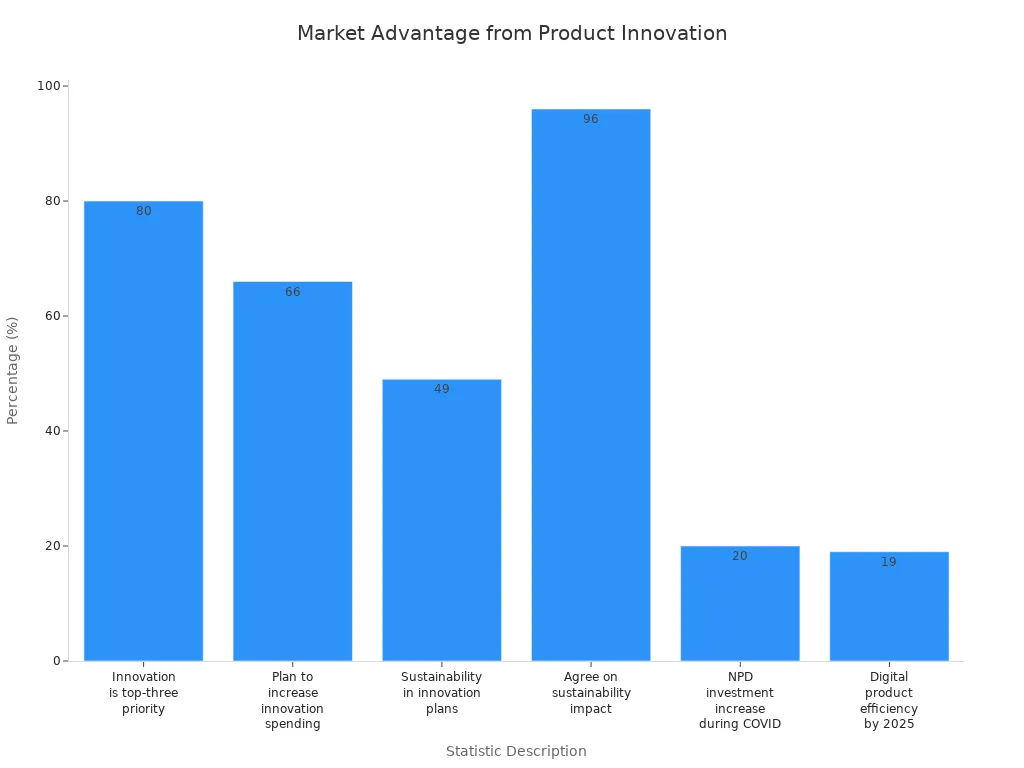
Product innovation is not just about making new things. It is about knowing what customers want and giving them value. When you focus on product innovation, you make a plan that meets customer needs and finds new chances. You also make your business stronger for the future.
Statistic | Description |
|---|---|
80% | Most top leaders say innovation is one of their three biggest goals. |
66% | Leaders want to spend more on innovation, and 42% will spend over 10% more. |
49% | Many leaders say sustainability is important for innovation and staying ahead. |
96% | Almost everyone agrees that sustainability helps companies compete. |
20% | The best companies spent more on NPD during the COVID-19 pandemic. |
19% | Digital product development should make things 19% faster by 2025. |
Samsung spent over $17 billion on research and development. Top companies spent over 20% more on product innovation during hard times. If you keep spending on product innovation, you give more value and meet customer needs. You also find new chances and help your business grow.
Operational Challenges to Innovation
Common Barriers for Companies
You want your company to be more innovative, but there are some big problems. Many companies do not have enough time. People are busy with daily work and cannot think of new ideas. Not having enough money also makes it hard to try new things or make products better.
Some people do not like change. They want to keep doing things the old way. This can stop new ideas and keep products from getting better. If everyone only works on what they already do, new product development gets ignored. When workers are not excited, they do not try to make things better.
Here are some common problems you might see:
Not enough time to think of new ideas
Not enough money for new projects
People do not want to change
Too much focus on current work
Workers are not interested
Other problems can happen too. The market might not be ready for change. Costs can make new ideas seem risky. Sometimes, old ideas make people think nothing new is needed. The coronavirus pandemic made things even harder for many companies. It can also be tough to find the right people to help with new product development.
Impact on New Product Development
These problems can slow down new product development. If you do not have enough money, you cannot hire the best people or buy good technology. Not enough workers means projects take longer and cost more. Old technology can make your product less good.
Rules and laws can also cause problems. You must follow rules about data, safety, and ideas. If you do not, you could get in trouble or lose money. Quality is important. If you rush, you might miss mistakes and have bad products.
Here is how these problems can hurt new product development:
Impact Type | Description |
|---|---|
Higher Costs | Bad processes use more time and money. |
Quality Problems | Rushing can cause mistakes and bad products. |
Longer Wait Times | Delays make customers upset and you lose sales. |
Market Position | Ongoing problems can hurt your spot in the market and lose customers. |
Company Survival | Not fixing these problems can put your business at risk. |
To do well with innovation, you need to be fast but also careful. Think before you act, plan well, and move quickly. Do not give up quality just to be fast. Good management helps you avoid mistakes and keeps your product strong.
Offloading Operations Effectively

You want your business to grow faster. You also want to launch new products quickly. Offloading operations is a smart way to do this. When you move routine tasks away from your team, you save time and energy. This gives your team more time for innovation. Here are some ways to help you offload operations.
Leveraging Technology and Automation
Technology can make your work easier. Automation helps you finish jobs faster and with fewer mistakes. You can use digital innovation strategies to help your business. Here are some tools you might use:
Business Process Automation helps you make work smoother and cuts down on mistakes.
Robotic Process Automation does boring jobs like typing data or handling papers.
Intelligent Process Automation uses AI and machine learning to handle hard tasks and learn from data.
These tools help you save time and money. Your team can focus on new ideas instead of boring work. You also get better results and can launch products faster.
Type of ROI | Description |
|---|---|
Operational ROI | Saves time, lowers workloads, and cuts ticket costs. |
Experiential ROI | Gives faster help, less switching, and happier people. |
Strategic ROI | Makes your business flexible, keeps talent, and strong. |
Companies using intelligent automation often get a 330% return in three years. This means you get more value for every dollar spent. Your business also gets stronger and ready for change.
Outsourcing Non-Core Tasks
You do not have to do every job yourself. Outsourcing lets experts handle jobs that are not your main focus. This is a key innovation strategy for many companies. You can spend more time on new products and getting them to market.
Common jobs companies outsource are:
Office work like typing data and making schedules
Human resource jobs like adding staff
Customer service, such as answering calls and emails
Marketing jobs like running social media and building websites
Retail support, such as handling orders
When you outsource these jobs, you have less work to do. You can use more resources for innovation and product development. This helps you launch products faster and stay ahead of others.
Outsourcing also makes it easier to work with other companies. You get help from partners with special skills. By letting others handle customer service, your team has more time for creative work. This leads to better products and happier customers.
Fishgoo is a good example of how outsourcing helps. Fishgoo handles shipping, storage, order handling, and customer service for online businesses. When you use Fishgoo, you do not worry about these daily jobs. You can focus on new products and reaching more customers. Fishgoo’s one-stop service makes teamwork easy and fast.
Streamlining Internal Processes
Streamlining means making your work smoother and faster. You want to cut out steps that slow you down. This helps your team work better and focus on new ideas.
Here are some ways to do this:
Automate jobs to save time and avoid mistakes
Use your team and tools in the best way
Use technology for better talking and data checks
Cut out work that does not help your business
Make better deals to save money
Train your team so everyone works well
Watch how things are going to fix problems fast
Use lean practices to get more value and less waste
Take care of equipment to stop breakdowns
Make customers happy to improve your products and services
When you streamline your work, you see real results. You work better and spend less money. Your business can change and grow faster. You make better choices using data. Your workers get more done and have more ideas. Customers get better service, which helps your business grow.
Measurable Outcome | Description |
|---|---|
Cuts out extra steps and speeds up work, making your team more productive and faster. | |
Reduced costs | Less manual work and waste, so you can spend more on new ideas. |
Increased agility & scalability | Lets you change quickly when the market changes, so you can grow without spending too much. |
Enhanced data-driven decision-making | Gives you data to find problems and make quick, smart choices, helping you innovate. |
Higher employee productivity | Makes daily work easier, so your team can focus on important jobs and new ideas. |
Better customer experience | Faster help and better service, so customers stay happy and your business grows. |
You can use these ways to build a strong base for innovation. When you offload operations and make your business smoother, it is easier to launch new products and react to changes. You also make a place where teamwork and new ideas can grow.
Tip: Start with one job to automate or outsource. See how it helps your team. Then try these ideas in other parts of your business. You will see big changes in innovation and growth.
Redirecting Resources for Product Innovation
Moving your focus from daily work to product development can seem hard. If you do it well, your business can grow and keep being creative. Let’s look at how you can set clear innovation and npd goals, build a creative team, use agile methods, and check your progress.
Setting Innovation Objectives
You need clear goals to help guide product development. These goals show everyone what is most important. Start by looking at five main areas:
Dimension | Description |
|---|---|
Innovation Scope | Set limits for your innovation work. Make sure it fits your company’s vision. |
Innovation Governance | Decide who makes choices and who is in charge of each part. |
Innovation Process | Plan each step, from idea to testing and launch. |
Resources | List the people, money, and tools you need for product development. |
Innovation Portfolio | Track all your projects to see if they match your big goals. |
Setting these goals gives your team a clear path. It also helps you check progress and change plans when needed. This keeps everyone working toward the same targets and stops wasted effort.
Tip: Check your goals often. Make sure they still fit your company’s vision and market needs.
Fostering a Creative Culture
A strong culture of innovation helps your team think big and try new things. You want people to feel safe sharing ideas, even if those ideas seem wild at first. Here are some ways to build this kind of culture:
Start brainstorming with open questions before narrowing down ideas.
Bring in new viewpoints from different industries or backgrounds.
Celebrate bold ideas, even if they don’t work out.
Make sure everyone feels safe to speak up.
Give your team time for unstructured thinking, like walking meetings or creative breaks.
Description | |
|---|---|
Encouraging Creativity and Experimentation | Let your team try new ideas and test them out. |
Fostering Open Communication and Collaboration | Make it easy for people to share and build on each other’s ideas. |
Embracing Risk and Failure | Treat mistakes as learning moments, not reasons for blame. |
Leadership's Role | Show your own excitement for new ideas and support your team’s efforts. |
Promoting and Rewarding Innovative Behavior | Recognize and reward people who try new things and help others do the same. |
You can also:
Support open talking and give resources for trying new things.
Hold brainstorming sessions in a safe space.
Encourage teams to test ideas and learn from mistakes.
Set up small groups to try new ideas.
Make it easy to get approval for new projects by cutting down on rules.
Give your team the tools and praise they need.
Building this culture helps your team stay excited about product development. It also makes it easier to change and grow.
Agile Methods in New Product Development
Agile methods help you move fast and stay flexible. You work in short cycles called sprints. You test ideas, get feedback, and make changes quickly. This helps you respond to what customers want.
Agile projects have a 39% success rate, much higher than traditional methods.
In big or complex projects, agile methods are nearly six times more successful.
93% of companies using agile report better customer satisfaction.
Agile principles focus on teamwork and quick feedback. You break big tasks into smaller steps. After each step, you check results and ask for feedback from users or team members. This way, you spot problems early and fix them before they grow.
Note: Agile capabilities help you launch products faster and improve the product experience for your customers.
Measuring Innovation Success
You need to know if your innovation efforts are working. Use clear metrics to track progress and spot areas for improvement. Here are some useful ways to measure success:
Metric | Description |
|---|---|
Innovation pipeline health | Track how many projects enter and leave your pipeline. |
Innovation portfolio health | Check if your projects match your main goals and perform well. |
Innovation system health | Look at how engaged your team is and how well your processes work. |
Time to market (TTM) | Measure how long it takes to go from idea to product launch. |
Idea generation rate | Count how many new ideas your team comes up with over time. |
Idea kill rate | See what percent of ideas don’t make it to market. |
Product kill rate | Track how many products stop during development. |
Weighted average portfolio risk | Add up the risks of all your projects to see if you’re taking on too much. |
Senior leadership innovation mix | Check how much time leaders spend on innovation activities. |
Employee innovation mix | Measure how much time your team spends on innovation and collaboration. |
You can also use feedback from customers and team members to improve your product and user experience. Ask for feedback often and use it to guide your next steps.
Step-by-Step Framework for Shifting Focus
Ready to redirect your resources? Here’s a simple framework to help you get started:
Assess Your Current State
Look at how much time and money you spend on operations versus product development.Set Clear Innovation and NPD Goals
Define what you want to achieve and how you’ll measure success.Offload Routine Tasks
Use automation, outsourcing, or process changes to free up your team.Invest in Your Team
Train your people in creative thinking, agile methods, and collaboration.Build a Culture of Innovation
Encourage open feedback, reward new ideas, and make it safe to take risks.Adopt Agile Practices
Break work into small steps, get feedback quickly, and adjust as you go.Measure and Improve
Track your progress with clear metrics. Use feedback to make changes and keep improving.
Remember: Keep improving all the time. Always look for ways to make your product development faster, smarter, and more creative.
Practical Tips for Implementation and Continuous Improvement
Ask your team for ideas to improve. People care more when they help shape the process.
Give your team the tools and training they need to do well.
Treat failures as learning moments. Talk about what went wrong and how to do better next time.
Use Lean and Six Sigma methods to cut waste and boost efficiency.
Use technology to track performance and gather feedback.
Set clear KPIs that match your main goals.
Celebrate wins, big or small, to keep your team motivated.
When you follow these steps, you build a strong base for product growth. You also create a culture of innovation that keeps your company moving forward. Your team will feel more engaged, your products will improve, and your customers will notice the difference.
Real-World Examples and Practical Tips
Case Study: Fishgoo’s One-Stop Service
How Fishgoo Enables Companies to Focus on Product Innovation
You want more time for your next product. Fishgoo helps you do that. Fishgoo handles logistics, warehousing, orders, and customer service for cross-border e-commerce. You can trust Fishgoo with routine work. Your team gets extra time to create and test new products. Fishgoo’s platform lets you focus on product development. You do not need to worry about shipping or storage. This gives you a smoother experience and helps you reach global markets faster.
Fishgoo’s one-stop service is easy to use. You paste a product link. Fishgoo buys from top Chinese channels, checks quality, and ships worldwide. You get reliable delivery and support. Your team can use their energy to improve products and design new features. Many brands use Fishgoo to enter new markets. They spend less time on operations and more time on product innovation. This helps you launch products quickly and improve customer experience.
Other companies also offload operations. Here is how some big names do it:
Company | Outsourced Function | Outcome |
|---|---|---|
Procter & Gamble | R&D | 60% more innovation, 400 new products, over $10 billion in revenue. |
IT support | Lower costs, better ad results, more focus on main work. | |
App development | Top talent, fast growth, and support in many languages. |
You can see how offloading routine work helps companies focus on product innovation and give a better experience.
Want to try this in your business? Here are some simple tips:
Tip | Description | Benefits | Example |
|---|---|---|---|
Risk Management | Find risks before starting a new product. | Avoid problems, build trust, keep things safe. | A retailer checks for website downtime before launching. |
Dual Operating Systems | Separate main work from innovation projects. | Balance resources, clear roles, better results. | A logistics team handles delivery while another tests drones. |
Monitor and Evaluate Performance | Track your product innovation work. | Make smart choices, improve, stay on target. | A hotel chain checks customer satisfaction for a new booking system. |
Leverage Technology and Automation | Use tech for routine jobs. | Save time, cut costs, focus on product strategy. | An accounting firm uses AI for tax prep. |
Engage Employees and Foster a Culture of Innovation | Let your team share ideas for new products. | More viewpoints, happier team, steady innovation. | Celebrate small wins to encourage risk-taking. |
You can use these tips to offload operations and give customers a better experience. When you focus on product innovation, you build a stronger business and stay ahead in the market.
When you let others handle operations, you can focus more on product innovation. This helps you save money and work faster. You also get to work with people from all over the world. Here are some benefits:
Benefit | Description |
|---|---|
Access to Global Talent | You can team up with experts from many countries to make your product better. |
Cost Reduction | You spend less on daily jobs and can use more money for new products. |
Enhanced Efficiency | Your work gets smoother, so you can launch products sooner. |
Specialized Skills | You get new skills that help you build a stronger product. |
Digital Transformation | New technology helps your product stand out from others. |
Ready to begin?
Try an Innovation Readiness Assessment to check if your team is set.
Use automation and workflow tools to do boring jobs faster.
Ask outside experts for new ideas for your product.
Make sure your team feels safe to share and try new ideas.
Look closely at how you make products now. Even small changes can help you win big later.
FAQ
How does offloading operations help my business grow?
You free up your team’s time. You can focus on new products and creative ideas. Your business moves faster and gets better results.
What tasks should I outsource first?
Start with jobs that take lots of time but don’t need your special skills. You can outsource customer service, order processing, or shipping.
Tip: Pick one task to outsource. See how much time you save.
Is Fishgoo safe for cross-border shopping?
Fishgoo checks every product for quality. You get clear prices and reliable shipping. Many brands trust Fishgoo for global orders.
Can I use automation if my team is small?
Yes! You can use simple tools for data entry, emails, or scheduling. Automation helps you work smarter, even with a small team.
Automation Tool | What It Does |
|---|---|
Email Scheduler | Sends emails for you |
Data Entry Bot | Fills forms quickly |
See Also
Maximizing Efficiency in Global E-Commerce Logistics Strategies
FISHGOO's Future Insights on Global Shipping Innovations
FISHGOO to Enhance Convenience for Chinese Product Purchases by 2025
Comprehensive Breakdown of JD Purchasing and Forwarding Services